

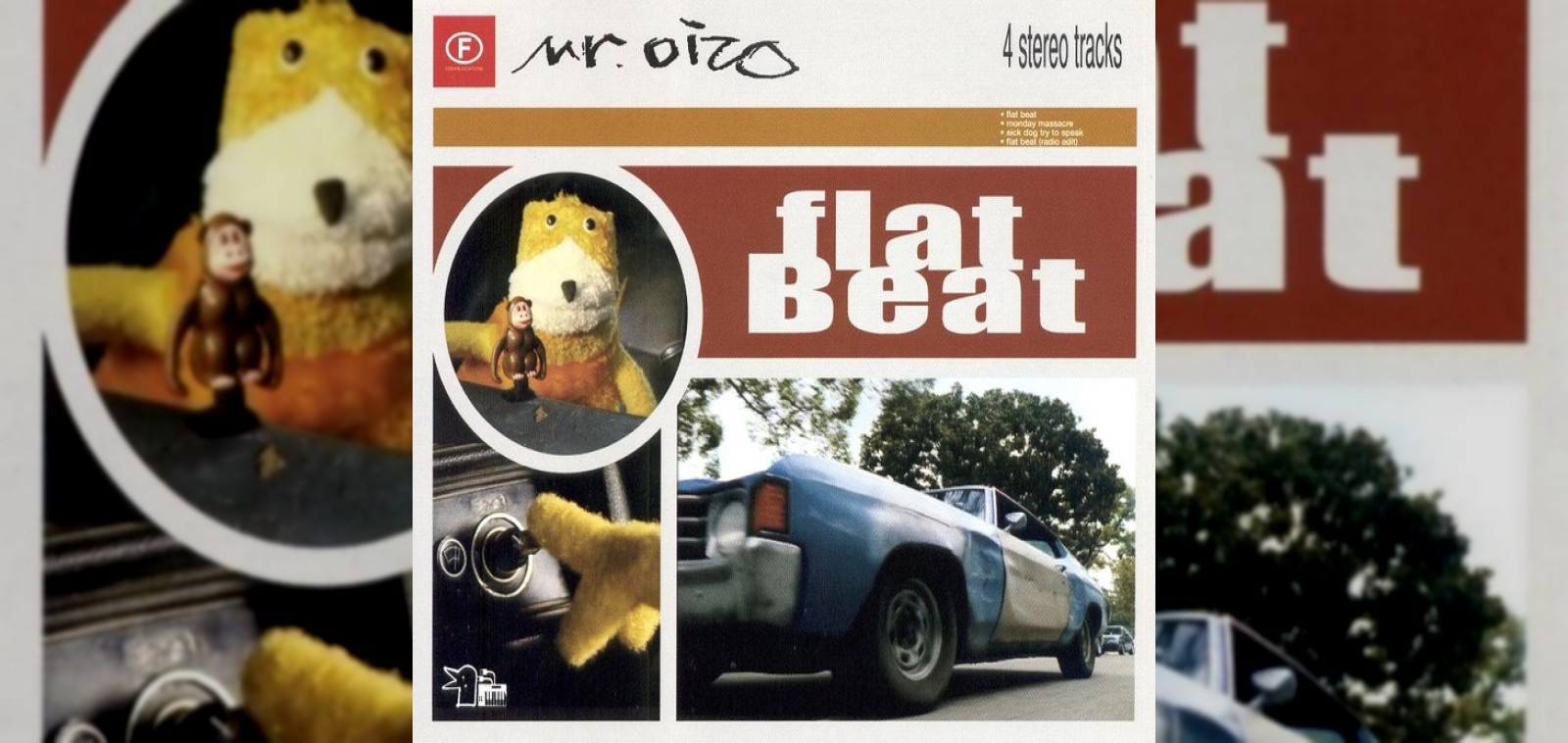
In January 1999 a yellow puppet with a flat head started head banging on European television, and within weeks DJs were playing a track that did not officially exist yet. That track was Mr Oizo Flat Beat, a loop built in roughly two hours by a 24 year old French director called Quentin Dupieux, and by the end of March it was the best selling single in Britain.
Twenty seven years later it still gets dropped in clubs. The story behind it is stranger than the puppet.
A loop made in two hours at his parents’ house
Dupieux was not a techno producer. He had come up making downtempo beats shaped by Wu Tang Clan and Beastie Boys records, and he was better known for directing videos than for anything club facing. “I was not a techno guy,” he told Red Bull Music Academy. “Because I was not aware of the technology and how this music was made, I was just trying to make it.”
The gear was modest. An AKAI SS1000 sampler, a cheap PC running a demo version of Cakewalk, a budget mixer, and the kick drum from a Roland TR 606 that Dupieux later described as maybe the weakest in the industry. The one piece that mattered was a Korg MS 20 he had bought secondhand from his friend Jackson Fourgeaud, who would go on to sign to Warp as Jackson and his Computer Band. That synth gave the track its gastric, plasticky squeal, and it has stayed in Dupieux’s sound ever since, a reminder that the machines behind these records tend to become collectors’ items long after the fact.
How DJs taped Mr Oizo Flat Beat off the television
The loop was never meant to be a record. Dupieux had put a rough version onto a Dictaphone and flown to Los Angeles to shoot three commercials for the Levi’s Sta Prest range, a job the agency Bartle Bogle Hegarty offered him after seeing the video for his earlier single “M Seq”. On set he cranked up the Dictaphone and made the puppet nod along to the beat. “Everybody freaked out,” he remembers, “like, woah, let’s keep this tune. It was not planned.”
The ads aired in January 1999 and connected immediately. Levi’s also ran them on MTV with the logo stripped off the end, which blurred the line between commercial and music video. Within weeks bootlegs were circulating. “It was just a stupid loop I did in two hours, with the beat and the bassline, and people were sampling it from the TV in really terrible sound quality so they could play it in the clubs,” Dupieux said. “It’s crazy when you think about it.”
So he went home, spent a few more hours extending the track and tidying the mix, and took it to every major label in Paris. All of them passed. The labels liked the commercial well enough, but they told him the track was not music.

A flea market puppet and a Jim Henson prototype
Flat Eric did not start life as a mascot. Dupieux found the original puppet at a flea market for a couple of francs, a faded head with no body and a smell to match. A friend stitched a furry body onto it for the “M Seq” video, where it went by Stéphane. When Levi’s wanted the character, nobody could establish who owned the rights to the original glove puppet, so the team commissioned a redesign from Jim Henson’s Creature Shop.
The brief was simple. Yellow, furry, not too close to the original. Something got lost anyway. “The person who was in charge of the project thought we were making a human size puppet,” Dupieux said. “She showed up with a puppet the size of a 10 year old kid. It was super scary.” They started over, and the version everyone recognises came out of that second attempt. The puppet got its name from its flat head. Dupieux took Mr Oizo from oiseau, the French word for bird, a nickname a friend had given him years earlier.
Two weeks at No. 1 and three million copies
The record found a home through a family connection. Laurent Garnier, who ran F Communications, had bought a car from Dupieux’s father, whose dealership sat next door to Garnier’s place. Garnier began testing Dupieux’s demos at the Rex Club in Paris, playing them off a cheap home CD player alongside house classics on vinyl.
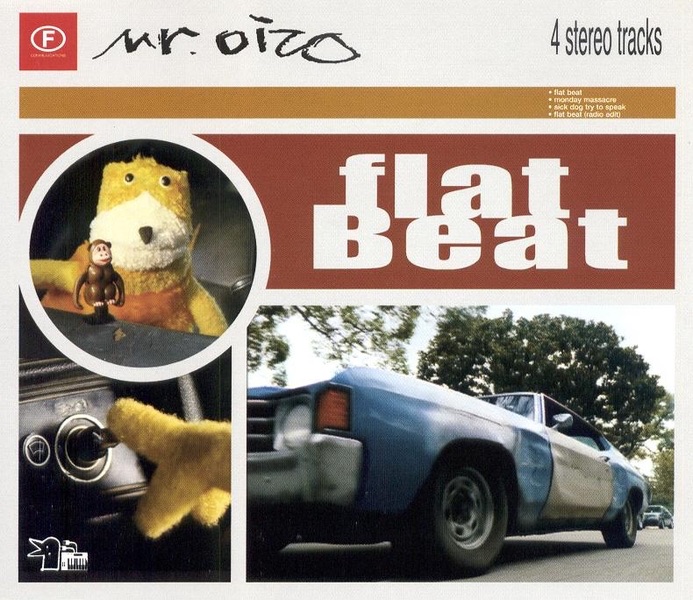
“Flat Beat” arrived on F Communications on 22 March 1999. It went straight in at No. 1 on the UK singles chart and held the top spot for two weeks, from 28 March to 11 April, topping the UK dance and independent charts at the same time. It was the seventh song from a Levi’s advert to reach No. 1 in Britain, and the 25th instrumental to manage it. The single also went to No. 1 in Austria, Finland, Flanders, Germany and Italy, peaked at No. 2 on the Eurochart Hot 100, and closed 1999 as the ninth best selling single of the year in the UK, certified platinum for 678,000 copies. Dupieux puts worldwide sales at around three million.
The one market that shrugged was his own. In France the track stalled at No. 5 with almost no radio play, selling roughly a quarter of what it moved in Britain.

What Flat Beat left behind
The track surfaced as a bonus cut on Analog Worms Attack later that year, and then Dupieux stalled. “The success was too big, and maybe not deserved, in a way,” he said. “For two, three, maybe four years, it was tough to find new inspiration.” He found his footing again in the mid 2000s around Ed Banger Records, where Justice, SebastiAn and DJ Mehdi were building the loud, distorted French sound that “Flat Beat” had sketched out first, and that fed directly into the electro house wave of the following decade.
The influence is easy to trace. Duke Dumont once ranked it ninth among UK No. 1 singles and called it possibly the first dubstep record. Mixmag and Stylus both put its bassline on best of all time lists. Skrillex borrowed from Oizo’s cartoon violence and the two eventually collaborated on “End of the World” in 2016. For the twentieth anniversary Dupieux released an EP called Rythme Plat, a flat rhythm for a flat head.
What makes the story hold up is how little of it was planned. A puppet from a flea market, a synth bought off a teenager, a placeholder loop recorded to a Dictaphone, and a wave of DJs pirating a jeans commercial because there was no other way to hear it. “It was perfect,” Dupieux said, “because nothing was planned. It’s just like a happy accident.”